
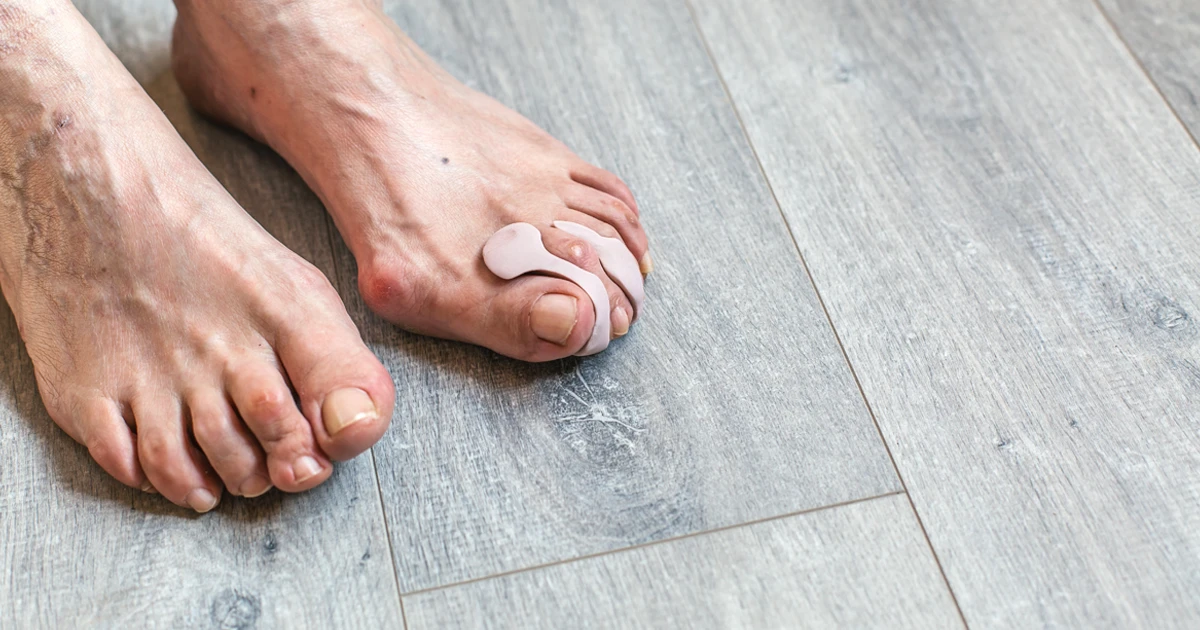
Bunion Correctors, Toe Spacers and Splints: What They Can and Can’t Do
Search online for help with a bunion and the first page is mostly products. Silicone spacers, hinged splints, night braces, each one sold with a photo of a big toe sitting neatly straight inside the device. And while it’s on, the toe often does look straighter. Unstrap it at night though, and the toe slides straight back to where it was that morning.
So the device changes how the toe looks for a few hours. Whether it changes anything about the foot itself is another question, and a good one to answer before you put money, or months, into a corrector.

Why the toe doesn’t stay straight once the splint comes off
A splint can’t hold its correction because a bunion is a change in bone alignment, not a soft-tissue lean that can be trained out. The first metatarsal, the long bone behind the big toe, drifts inward towards the other foot, and the big toe angles back towards the second toe to compensate. The lump on the side of the foot is mostly the head of that metatarsal pushing outward. It isn’t new bone growing there, which surprises a lot of people.
All a splint really does is pull on the soft tissue around the toe. The metatarsal doesn’t move. The research on splints and spacers is fairly thin, and what there is points in a consistent direction: many people find them more comfortable to wear, but any change in the underlying angle tends to be small, and it doesn’t hold once the device is no longer being worn.
Which matters, because plenty of people are buying these. A 2010 review in the Journal of Foot and Ankle Research put bunions at around 23% of adults aged 18 to 65, and close to 36% once you’re past 65.
Where correctors and spacers do earn their place
None of that makes them useless. They just do a different job from the one on the packaging. For plenty of people with a mild, flexible bunion, a few simple measures keep the foot comfortable for years:
- A toe spacer between the first and second toes, mainly to stop the two rubbing in closed shoes
- Gel sleeves or padding over the bump, right where the shoe presses hardest
- A night splint, if it eases morning stiffness (some people swear by it, others notice nothing)
- Shoes with a wide, deep toe box, which probably does more than everything above combined
Footwear is the unglamorous one. A narrow, pointed shoe pushes the big toe in exactly the direction the bunion is already heading, and no spacer fully cancels that out across an eight-hour workday.
So these devices manage symptoms. A bunion that's progressing will usually keep progressing underneath them, quietly, regardless of how comfortable the spacer feels.
When conservative care has run its course
Pain and function decide it, far more than size. A large bunion that doesn't hurt and still fits comfortably in shoes is often best left alone, and correcting a foot purely for appearance isn't generally recommended. The signs that padding and spacers are no longer keeping up look more like this:
- Pain over the joint most days, not just in particular shoes
- A big toe that has started crowding, or riding under, the second toe
- New calluses under the ball of the foot, where load has shifted away from the big toe
- A growing pile of shoes that simply can't be worn anymore
Don't ignore the second toe. After enough time with the big toe pushing into it, it can start to buckle, or the joint underneath gets sore on its own. Now there are two problems instead of one. Often it's that second toe, not the bunion, that finally gets someone through the door for a referral.
What correction actually involves
If you've properly given better shoes and padding a go and the pain hasn't let up, bunion surgery is a fair thing to talk about. It doesn't have to be a last resort. Surgery realigns the bone itself, and no splint can do that. For many forefoot corrections, Mr Goldbloom uses a keyhole (minimally invasive) technique, working through a few small incisions instead of one longer cut. It won't suit every foot, though. How severe the deformity is and the state of the joint both come into it, along with what the X-rays show, so it's decided case by case.
A spacer that keeps you comfortable is doing its job, and there's no need to rush past it. Once it's only taking the edge off a joint that aches most days, though, a specialist assessment will tell you more than another device will. You can arrange one by calling the practice on 03 9650 0534 or through the online enquiry form
Bunion surgery doesn't have to be a last resort
A spacer that keeps you comfortable is doing its job. Once it's only taking the edge off a joint that aches most days, a specialist assessment will tell you more than another device will.
To book a consultation with orthopaedic foot and ankle surgeon, Mr Goldbloom, please call 03 9650 0534
